Top cold air intakes for utes and 4x4s in Australia: best picks for Hilux, Ranger and Navara
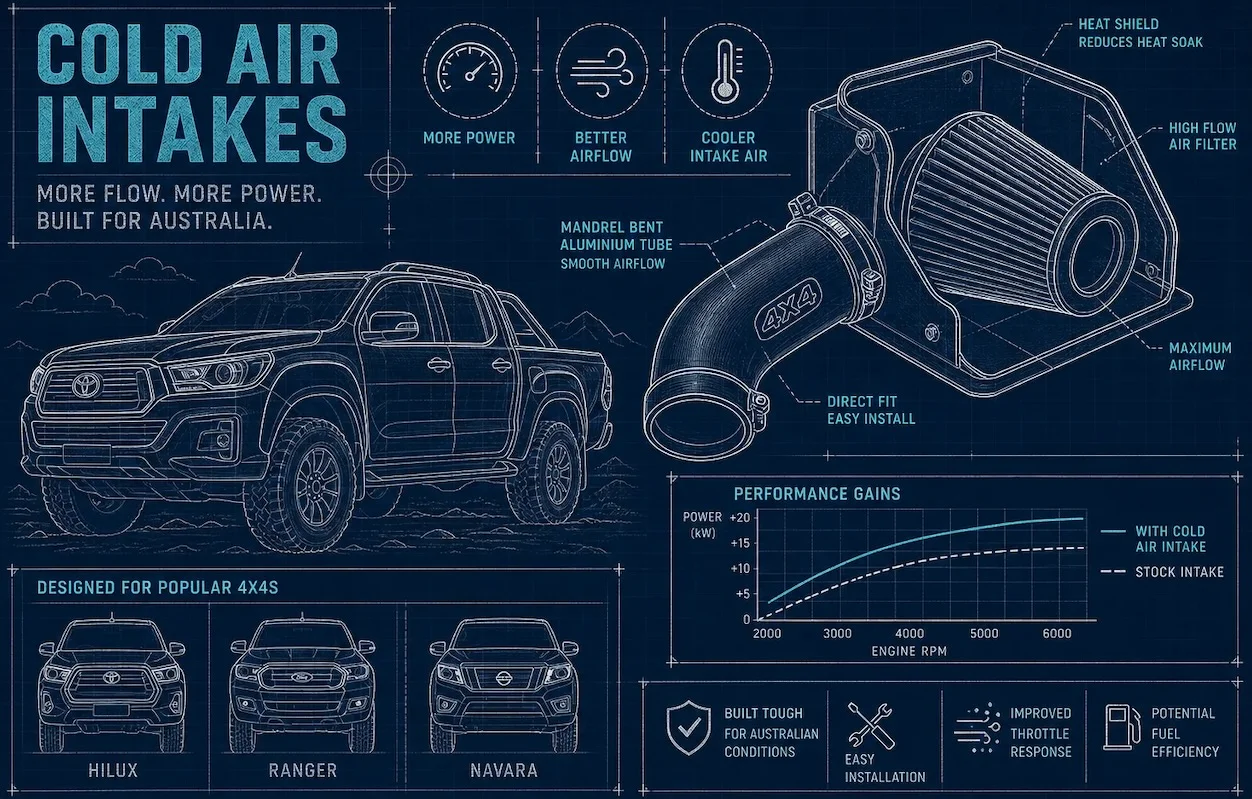
A sealed cold air intake fitted to a stock turbo-diesel ute typically produces 3–10 wheel horsepower and 5–20 Nm at the wheels, with the most noticeable change being sharper throttle response above 2,500 rpm. Open-pod kits that claim 15–25 hp are usually reporting manufacturer best-case numbers measured under ideal conditions, not what you will see on a standard Hilux or Ranger.
This article is written for Hilux, Ranger, Navara and Patrol owners weighing up whether a performance air intake is worth the money. Vehicle-specific fitment, Australian compliance, and pairing with the right exhaust system are what separate a successful install from a wasted upgrade.
Key takeaways
- Realistic wheel gainsExpect 3–10 whp and 5–20 Nm on a stock turbo-diesel ute; throttle response improvement is usually the most noticeable benefit in everyday driving.
- Sealed systems winFor Australian heat, dust and water crossings, a sealed airbox with proper ducting outperforms an open-pod on every practical measure.
- Compliance mattersRetain every factory sensor, breather, and emissions connection; a dedicated, application-matched kit is the safest path in every Australian state.
- Fitment is engine-code specificThe Navara D23 alone has four engine variants with different MAF, PCV and turbo arrangements; match the kit to the exact code, not the model name.
- Pair with a performance exhaustAn intake improves airflow in; a quality exhaust reduces backpressure out; the combination produces better results than either upgrade alone.
- Warranty is not automatically voidedUnder Australian Consumer Law, a manufacturer must demonstrate the intake caused the specific fault before refusing a claim.
What does a cold air intake actually do?
A cold air intake replaces the factory airbox and draws air from a lower, cooler location outside the engine bay's heat-soak zone. Cooler air is denser, meaning more oxygen per cubic metre and more fuel can be burned per combustion cycle. The factory airbox is engineered around cost, packaging and noise, not maximum airflow, so there is genuine headroom to improve.
Cold air vs short ram intake: which works better in Australian conditions?
The table below compares a sealed cold air intake system against an open-pod or short-ram design on the criteria that matter most to Australian 4x4 and ute owners. For Australian summers, outback dust, and the regular water crossings that come with genuine off-road use, the sealed system wins on every practical measure.
| Factor | Sealed cold air intake | Short-ram / open-pod intake |
|---|---|---|
| Heat soak risk | Low when properly sealed and ducted to the grille or guard | High; filter sits in the hot engine bay and loses gains in traffic |
| Water ingestion risk | Higher at crossings due to low filter position; needs snorkel integration | Lower filter position risk, but exposed to heat and debris |
| Compliance risk | Low with a vehicle-specific, sensor-retaining sealed kit | Higher; open pods can attract defect notices for noise or unshielded operation |
| Installation complexity | Moderate; longer ducting required | Simple; short, direct path |
| Throttle response | Strong improvement, particularly under load at highway speeds | Feels immediate at low RPM but heat soak erases it in stop-and-go |
| Peak power consistency | Consistent across a hot run; gains hold through repeat pulls | Inconsistent; the second run on a dyno often shows lower numbers |
Dust and water crossings
Dust ingestion is a real risk for unsealed filters on unsealed roads, and no cold air intake system eliminates hydrolock risk entirely. A low-mounted filter needs protection at water crossings; a snorkel is the practical solution for vehicles that regularly cross running water.
How much power will a cold air intake add to your build?
The table below presents realistic wheel figures drawn from before-and-after tests on the same dyno, with the same correction standard and the same intake-air temperature. These are not flywheel estimates or manufacturer claims.
| Vehicle and engine | Typical wheel power gain | Typical torque gain |
|---|---|---|
| Toyota Hilux 2.8 GD-6 | 2–7 whp | 5–15 Nm |
| Ford Ranger 2.0 BiTurbo | 3–8 whp | 8–20 Nm |
| Ford Ranger 3.0 V6 diesel | 3–10 whp | 8–25 Nm |
| Nissan Navara (YS23 diesel) | 2–8 whp | 5–20 Nm |
Manufacturer claims of "+15 hp" should be treated as upper-end results until independently verified with a complete before-and-after dyno sheet showing the same vehicle, fuel, correction standard and repeatable runs. A sealed, application-matched aftermarket intake system on an otherwise standard diesel ute produces real but modest peak-power gains. The throttle response improvement is where most owners notice the difference first.
When a tune makes the real difference
A cold air intake alone on a stock ECU is limited by factory fuel mapping. Pair the intake with an ECU tune and the gains compound, but the tune should be attributed separately, not lumped in with intake claims. For a standard commuter ute, intake plus tune is the correct comparison against "intake alone," and the two should be budgeted as separate upgrades.
Is a cold air intake legal in Australia?
Australian Design Rules (ADRs) are national standards; a modified vehicle must continue to comply with the rules that applied at manufacture. A replacement intake that retains the PCV, EVAP, MAF and IAT sensors, breather lines and all emissions equipment is treated as a lower-risk modification. Removing or bypassing any emissions hardware is a compliance breach regardless of which state you are in.
State-by-state snapshot
NSWNew South Wales
Sealed, vehicle-specific systems that preserve all sensors are generally acceptable; significant changes may require assessment through the NSW Vehicle Safety Compliance Certification Scheme.
VICVictoria
Modifications must comply with the relevant ADR provisions, and written approval from VicRoads may be required for changes that affect the induction system.
WAWestern Australia
Some intake modifications are classified as "simple" modifications and can be inspected at an Authorised Inspection Station without prior written approval, provided the VSB 14 checklist and permit process are followed.
QLDQueensland
Low-risk bolt-on intakes that retain all factory sensors and emissions equipment generally do not require a QIIS inspection.
SASouth Australia
Comparatively strict rules: vehicles manufactured from 1 January 1974 must generally retain the original induction system unless the change has been approved.
OtherTAS, ACT, NT
VSB 14 is the common technical benchmark, but its legal weight and inspection process vary by jurisdiction.
A practical compliance checklist before fitting
- Retain the factory MAF and IAT sensors with the correct orientation and breather connections.
- Keep the catalytic converter, EVAP, PCV, and all emissions equipment untouched.
- Ensure the filter is enclosed, firmly mounted, and protected from water ingestion.
- Keep the original airbox so the vehicle can be returned to standard if required.
- Retain all documentation, including invoices, installation instructions, and any approval certificates.
The safest rule
A sealed, dedicated intake kit that changes nothing in the emissions circuit carries the lowest compliance risk in every Australian state.
Which cold air intake kit fits your ute or 4x4?
For Hilux, Ranger, Navara and Patrol use, a sealed airbox system with ducting to the grille or guard area is the correct starting point. Open-pod filters generate a better intake note but perform inconsistently in hot weather and fail at water crossings.
Vehicle-specific fitment: what to check for Hilux, Ranger and Navara
Match the kit to the exact engine code, year and transmission. The Ranger 2.0 BiTurbo and 3.0 V6 require different inlet routing, and the MAF housing diameter and sensor orientation must match the factory ECU calibration. A mismatched MAF position causes fuel-trim faults even if the pipe physically fits.
The Navara D23 is a particularly important example of why engine code matters. The YS23DDT single-turbo (163 hp), YS23DDTT twin-turbo (190 hp), YD25DDTi and QR25DE petrol all have different MAF flanges, PCV port positions, sensor wiring and turbo arrangements. A kit labelled simply "D23/NP300" is not sufficiently specific. Confirm the exact engine code and power output before ordering, and check photographs of the MAF flange and PCV port against the factory arrangement. For RHD battery and wiring loom positions, use a model-specific kit rather than a universal system.
Our Parts Finder provides vehicle-specific fitment. K&N kits are among the stocked brands and ship free on orders over $200 across Australia. If the Parts Finder returns multiple options, our team in Sunbury, with over 60 years of combined family experience in exhaust and 4x4 accessories, is available to help you work through the options.
How to install and maintain a cold air intake at home
Installation is DIY-friendly on most utes if you work methodically. Most owners complete the job in two to three hours with basic hand tools; the most expensive mistakes come from skipping the preparation steps rather than from the technical complexity of the job itself.
- Check the kit against the parts list before touching the vehicle.
- Disconnect the negative battery terminal before unplugging the MAF or any powered sensor.
- Remove the factory airbox; photograph all sensor locations and breather routing before disconnecting anything.
- Transfer the MAF sensor with the correct orientation as specified in the kit instructions, using the supplied O-ring or grommet.
- Reconnect every breather line, PCV connection and vacuum port.
- Install the heat shield and check clearance from the bonnet, radiator fan, belts and wiring.
- Start the engine; check for air leaks, warning lights and bonnet clearance before road testing.
Filter maintenance: what to check and when
A K&N oiled cotton-gauze filter should be inspected at every service interval. The practical guide for when to clean is straightforward: if the wire mesh screen is no longer clearly visible through the filter media, it is time to service the element. Dusty outback, unsealed-road or convoy driving demands far more frequent attention than highway use; do not rely on a fixed distance interval in those conditions.
Most common DIY mistake: over-oiling
Excess oil migrates into the MAF sensor and causes fuel-trim faults. Apply oil evenly along the crown of each pleat, allow 20 minutes for it to wick through, and touch up any pale areas until the filter shows an even colour across the entire surface.
Pairing with a performance exhaust for real gains
Think of it as balancing both ends of the engine's breathing: an intake improves the air coming in; a quality exhaust reduces the backpressure on the way out. Together they produce better results than either upgrade alone. Ignite Exhausts is Playtime's in-house brand, CNC mandrel-bent in 409 stainless steel at our Sunbury facility. For builds focused on Hilux, Ranger or Navara platforms, an Ignite system combined with an application-matched intake kit is a logical pairing for owners looking to improve both throttle response and power delivery.
Making the call: is a cold air intake right for your build?
A sealed, vehicle-specific cold air intake kit delivers 3–10 whp, 5–20 Nm and noticeably sharper throttle response on a stock turbo-diesel ute. The upgrade earns its price when paired with the right performance exhaust system and when the vehicle is genuinely used to its capacity: loaded, towing or on long highway pulls. If the ute is standard in every other way and the driving is mostly urban, the throttle response improvement is real but the peak-power gain is modest.
Under Australian Consumer Law, fitting an aftermarket intake does not automatically void your new-car warranty. A manufacturer must demonstrate that the intake caused the specific fault before refusing a claim. Keep the original airbox, retain your installation records, and ask for any warranty refusal in writing with the specific causal link identified.
For the best outcome, use our Parts Finder to select the correct application-matched kit, retain every factory sensor and emissions connection during installation, and consider an Ignite Exhausts system from our Sunbury workshop as the natural next step. Cold air intake upgrades done right are one of the cleanest, most reversible performance modifications available for Australian utes and 4x4s. Get in touch with our team in Sunbury if you want a second opinion on fitment before you buy.
Frequently asked questions
Will a cold air intake improve my ute's fuel economy?
It will not reliably improve fuel economy; the primary benefits are sharper throttle response and modest peak-power gains. Any fuel-use change depends on how you drive after the upgrade, and the intake alone is limited by the factory fuel mapping unless you add a tune.
Does fitting an aftermarket intake automatically void my new-car warranty?
No, fitting an aftermarket intake does not automatically void your new-car warranty under Australian Consumer Law. A manufacturer must demonstrate the intake caused the specific fault before refusing a claim, so retain the original airbox, installation records and ask for any warranty refusal in writing with the causal link specified.
Can I use a snorkel to protect a low-mounted sealed filter at water crossings?
Yes, a snorkel is the practical solution for protecting a low-mounted filter during regular water crossings. A sealed airbox with snorkel integration reduces water-ingestion risk, whereas open-pod and short-ram designs remain poor choices for frequent water or dusty off-road use.
How often should I service the filter if I drive on dusty outback roads?
You should inspect and service the filter far more frequently than highway-use intervals when driving dusty outback or on unsealed roads. Check the element at every service interval and clean it whenever the wire mesh screen is no longer clearly visible through the media, and take care to avoid over-oiling which can cause MAF faults.
Do I need an ECU tune to see the full benefit of an intake?
An ECU tune is not mandatory but it compounds the gains; the intake alone produces real but modest peak-power increases. If you want the combined effect, budget for the intake and tune as separate upgrades and treat the tune as a distinct contribution to overall performance.